
Most SaaS teams discover affiliate marketing the wrong way — by bolting a clunky referral form onto their pricing page after a board meeting where someone asked “what about partner-led growth?”. Six months later they have three inactive partners, no tracking, and a spreadsheet nobody looks at.
SaaS is actually one of the best fits for affiliate marketing — better than e-commerce, better than info products, better than most B2C categories. Recurring revenue, high gross margins, long customer lifetimes and a tooling ecosystem (Stripe, Webhooks, APIs) that makes attribution clean. The teams that run real SaaS affiliate programs see 10% to 15% of their MRR come through the channel within a year, at a blended CAC that sits below paid acquisition.
This guide is the playbook we wish someone had handed us in 2023.
Why SaaS is the perfect fit for affiliate marketing
Every acquisition channel has a fit score with a given business model. SaaS scores high on affiliate because of four structural reasons:
- Gross margin > 80%. You can afford to share 20–40% recurring with a partner and still come out massively ahead of paid channels that burn cash upfront.
- Recurring revenue. The math works per-cohort. A €500 ACV customer with a 30-month LTV covers a €100 affiliate bounty 15 times over. Paying recurring? Even better — the channel scales with retention.
- Measurable attribution. Stripe emits structured events. Cookies, URL params, server-side tracking via first-party CNAME — you actually know which partner drove which subscription. Not the case for most e-commerce impulse-buy SKUs.
- Content marketing gravity. Your best affiliates are consultants, content creators, newsletters and YouTube reviewers who already rank for long-tail queries like “best affiliate tracking SaaS” or “rewardful vs firstpromoter”. They own the distribution you are trying to buy.
If your product checks those four boxes, a real affiliate program is probably worth more than another performance marketer on your team.
What a modern SaaS affiliate program looks like
Not every program is the same. There are three archetypes and most successful SaaS programs pick one and commit. Mixing them confuses partners and kills the momentum that makes the channel work.
- Creator & consultant program. 10–50 partners, 20–30% recurring commission, lifetime or 24 months. Built around content creators, podcasters, industry consultants who integrate your product into their editorial universe. This is the highest-quality cohort — payback is long but compounding.
- Partner & agency program. Agencies reselling, rebranding, or installing your product for clients. Lower partner count, higher per-partner ACV, often with tiered commissions (15% / 25% / 35% based on volume). Requires account management and co-marketing.
- Customer referral program. Your existing users get a link, share it with peers, earn credit or cash. Lower touch, higher volume, lower per-partner value. Works well as a compounding add-on to one of the two above — not usually strong enough to stand alone.
Pick one. Do it well. Mix them at your scale-up phase, not on day one.
Commission design: the actual decision that matters
This is the single choice that determines whether your program compounds or flatlines. Four dimensions to decide:
1. Commission model
Recurring. Default for any subscription product with good retention (> 70% 12-month). Aligns the partner's incentive with your retention team's. A partner paid recurring will quietly push customers toward the right plan, answer support questions, and stop referring the wrong-fit prospects — because they want the customer to stay.
One-time bounty. Works when your CAC is fixed (e.g. you only allow annual plans), margins are thinner, or when you need partner payout simplicity. Common range: €50–€300 depending on ACV.
Hybrid. €100 signup bounty + 10% recurring for 12 months. Rare but useful when onboarding effort is high and you want to reward partners for closing the deal before churn can test the product.
2. Rate
Benchmarks for B2B SaaS in 2026:
- Aggressive (to attract top creators): 30–40% lifetime recurring
- Balanced (most mature programs): 20–25% recurring for 12 or 24 months
- Conservative (self-serve, low-touch): 10–15% lifetime
Programs paying below 10% recurring rarely attract serious partners. You are competing with tools that pay 30% — creators do the math.
3. Duration
Lifetime vs. limited (12/24 months). Lifetime is the most partner-friendly and usually the right default for strong-retention products. Limited duration caps your acquisition cost deterministically, which boards occasionally prefer for modeling purposes — but it also caps your partner enthusiasm once they hit the cliff. If you cap, cap at 24+ months, not 12.
4. Hold period
The window between “commission created” and “commission payable”. For recurring and sale commissions: 30 days. This catches chargebacks and early refunds before you pay the partner. Lead commissions (flat payouts for trial signups or demo bookings) need less — 3–7 days. Skipping hold periods means every refund becomes a painful clawback conversation.
The technical setup (what to build or buy)
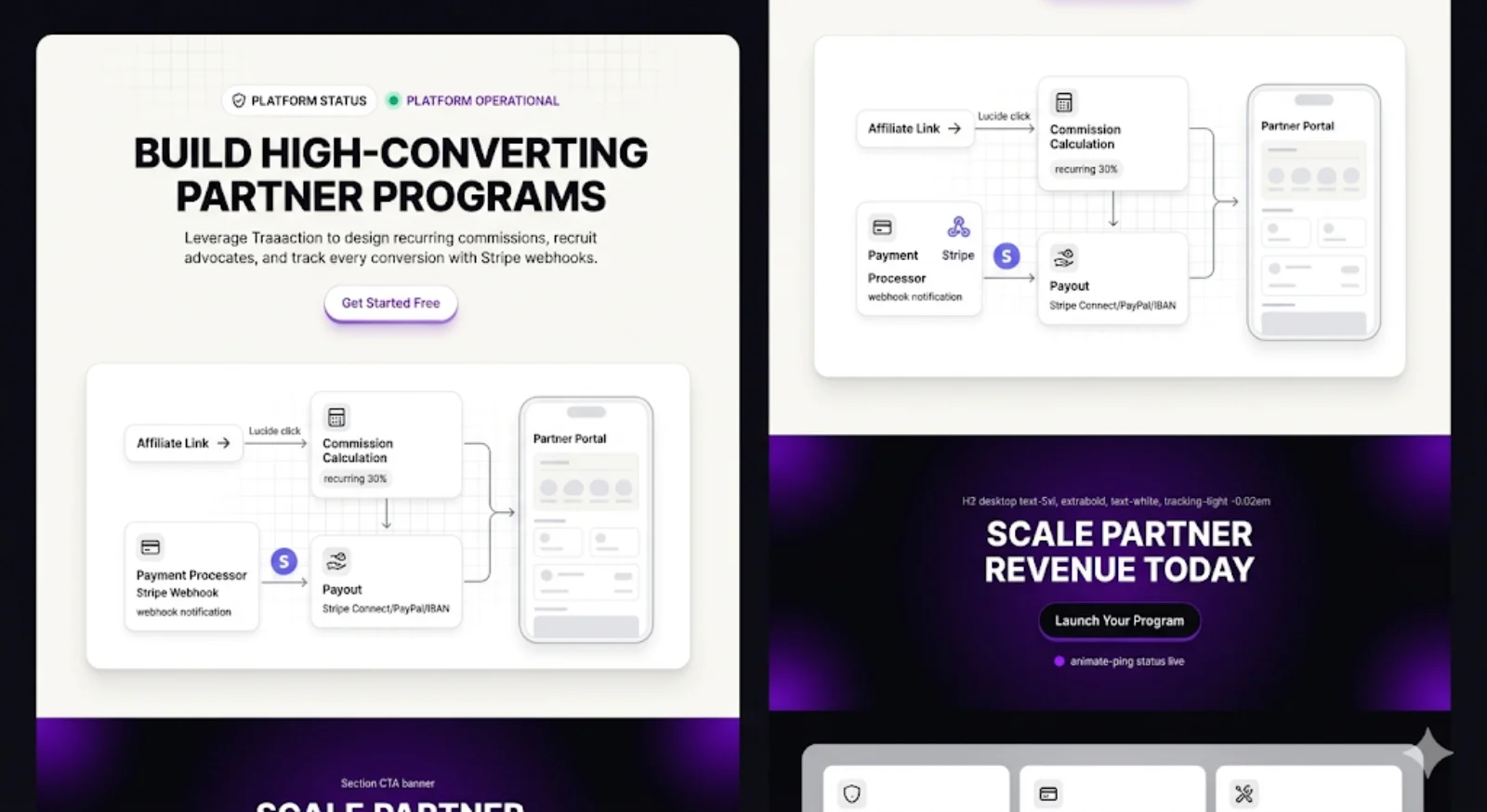
A working SaaS affiliate program needs five technical pieces:
- Click attribution. Short link → cookie →
trac_click_id(or similar) on the checkout session. First-click, 90-day cookie, protected against iOS 14 ITP via first-party tracking. - Stripe webhook receiver. Four events:
checkout.session.completed,invoice.paid,charge.refunded,customer.subscription.deleted. Each idempotent and logged. See our deep dive on tracking affiliate sales with Stripe webhooks. - Commission engine. Calculate, hold, mature, pay. Clawback on refund. Month counter for recurring. This is where most homegrown implementations fail — the edge cases around proration, mid-cycle upgrades and subscription pauses are brutal.
- Partner portal. Signup flow, link generator, performance dashboard, marketing resources, payout preferences. White-label on your domain — partners.yourbrand.com outperforms a generic vendor URL by 2–3x on signup conversion.
- Payouts. Stripe Connect for affiliates with US/EU bank accounts. PayPal for international. IBAN SEPA for European affiliates who want direct bank transfers. Lock yourself to Stripe-only and you exclude half the creator economy.
Build it yourself and you are signing up for 2–3 months of engineering plus ongoing maintenance on a surface area that is not your core product. Most teams use a dedicated platform — see how Traaaction compares to Rewardful, FirstPromoter, Tolt and PartnerStack.
Recruiting partners who actually ship
A program without partners is a commission calculator. The hard work starts the day you press Launch. Three sources, roughly in order of quality:
- Your existing customer advocates. The people who already post screenshots of your product on Twitter/X, tag you in LinkedIn posts, or mention you in their newsletter. Reach out individually, not via a blast. Give them a custom link and a handwritten note.
- Content creators in your category. Google
“best {your category} tools”, find the 30 pages that rank, email their authors with a specific offer (including a custom commission if they drive volume). Expect a 10–20% reply rate if you personalize. Automate this and reply rate drops to 1%. - Industry consultants and agencies. The highest ACV per partner. They deploy your product inside 5–10 clients per year. Tiered commissions with co-marketing commitments work here. Do not approach them the same way you approach creators — they want different things (lead-gen support, joint webinars, preferred pricing).
Avoid affiliate marketplaces (ShareASale, Impact, etc.) as your primary recruitment channel for early-stage SaaS. They bring volume of low-intent coupon sites that tank your blended affiliate quality.
Metrics that matter (and the ones you can ignore)
You will be tempted to track everything. Resist. For the first 12 months of a program, four numbers matter:
- % of new MRR from affiliates. Target 5% by month 6, 10–15% by month 12. Below 3% after a year means your program is not pulling its weight (or you need to recruit harder).
- Affiliate-sourced LTV:CAC. Should be > 3x, ideally > 5x. If it dips below 3x, revisit your commission rate or cap.
- Active partner count. Partners who drove at least one paid customer in the last 90 days. If this is flat or shrinking, your program has a retention problem — usually late payouts, unclear rules or missing dashboards.
- Refund rate by affiliate source. If one partner drives 25% refund rates vs. your blended 4%, they are attracting the wrong audience. Offboard them.
Revenue per partner, click-through rates, cookie windows — these matter tactically but do not drive the big decisions in year one.
Common pitfalls
The mistakes that kill 80% of early-stage SaaS affiliate programs:
- Commission too low to matter. 5% recurring on a €30 plan is €1.50/month. No serious partner is going to produce content for €1.50/month.
- Launching without a payout rail. “We will figure out payouts when someone earns something.” Your first partner earns commission, waits three weeks for a reply, and quietly stops promoting. Set up payouts before launch.
- No hold period. You pay out, customer refunds, you now owe the partner a negative balance they will never agree to.
- Last-click attribution. A partner drives the initial click, the user visits 3 times, last visit comes from your own paid search. Credit goes to paid search. Partner churns. Use first-click or weighted attribution with hold.
- No portal. Partners wanting to check their earnings email support. Support copy-pastes from a dashboard. Friction compounds until partners leave.
Launch checklist
A SaaS affiliate program is live when all ten are true:
- Commission model chosen (recurring / bounty / hybrid) and documented
- Rate, duration and hold period set per commission type
- Stripe webhooks configured for all four events, tested end-to-end
- First-click attribution cookie with 90-day TTL
- Partner portal with custom domain live (partners.yourbrand.com)
- Signup, approval and link generation flows tested from scratch
- Payout rails configured (Stripe Connect + PayPal + IBAN minimum)
- Terms of service & acceptable use policy published
- First 10 partners onboarded manually with custom outreach
- Weekly dashboard email shipping to partners (earnings + tips)
Launch your SaaS affiliate program
Traaaction is built for exactly this playbook. Recurring commissions native to Stripe subscriptions, first-party CNAME tracking, hosted portal with custom domain, multi-payment payouts (Stripe Connect + PayPal + IBAN), and zero per-sale fees — the commission budget stays with you.
The free plan covers up to €500 of affiliate revenue per month, which is enough to run the first 10–20 partners and validate whether the channel is working for your product. No credit card, no trial expiry.
Related reading: recurring commissions for SaaS, how to pick a commission structure, and our deep dive on Stripe webhook integration for affiliates.
Frequently asked questions
What commission rate is typical for a SaaS affiliate program?
Direct-sale SaaS programs typically pay 20% to 40% recurring on net revenue, with the top end reserved for the first 12 months or for high-LTV products. One-time bounties average €50 to €200 depending on ACV. Programs paying below 15% recurring struggle to attract serious content creators and consultants.
Recurring or one-time commission for a SaaS?
Recurring wins for subscription products. It aligns affiliate incentives with retention, attracts long-term creators, and amortizes acquisition over the customer lifetime. One-time bounties only make sense when margins are thin or when you need instant payout simplicity — typical for lower-ACV, high-churn tiers.
How long does a SaaS affiliate program take to launch?
A modern stack ships live in under an hour. The meaningful work is partner recruitment and content — expect 60 to 90 days to see your first meaningful MRR contribution, and 6–12 months before affiliates hit 10% of new MRR.
What Stripe events do I need to track?
Four events: checkout.session.completed (attribution + month 1 commission), invoice.paid (month 2+ renewals), charge.refunded (clawback), customer.subscription.deleted (cancellation cleanup). Each must be idempotent and attribution must be first-click — never overwritten on repeat checkouts.
How do I prevent affiliate fraud?
Four layers: hold periods (30 days for sale/recurring so chargebacks land before payout), cookie-based first-click attribution (not last-click, which self-referrals exploit), manual approval for partners driving unusually high volume from low-quality channels, and automatic clawbacks cascading through any referral tree on refund.
Can I run an affiliate program without Stripe?
Yes. Any payment processor that emits webhooks works (Paddle, Chargebee, Braintree). The essentials are the same: a checkout event with attribution metadata, a renewal event, a refund event, and a cancellation event. Self-hosted billing works via a REST API and your own event emission.